Your home server,reimagined.
HomiOS is a self-hosted, beautifully designed browser operating system for your home server. Keep your apps, files, and services in one place with a clean, modern interface.


“Your homie doesn't judge what hardware you've got. Neither does HomiOS.”
You shouldn't need a purpose-built rack server, matching enterprise drives, or a four-figure NAS just to build a useful home server.
Built-in battery acts as an uninterruptible power supply (UPS). Built-in screen for emergency debugging. Perfect low-power 24/7 home server.
Intel N100 or used office desktop? Silent, compact, and sips single-digit watts while running Docker containers and file streaming.
A SATA HDD, two random USB SSDs, and an NVMe boot drive. HomiOS handles mismatched capacities without forcing traditional rigid RAID arrays.
Instead of digging through man pages, cryptic filesystem config files, and systemd services, HomiOS turns the raw power of Linux into four straightforward visual actions.
HomiOS discovers connected storage and lets you manage it visually. USB SSDs, SATA HDDs, NVMe drives, and Linux block storage live together without forcing you into rigid arrays.
Linux often reorders drive letters like /dev/sdb to /dev/sdc after a reboot or USB re-plug. HomiOS tracks drives by persistent filesystem UUIDs so protection policies and mount points never get mixed up.
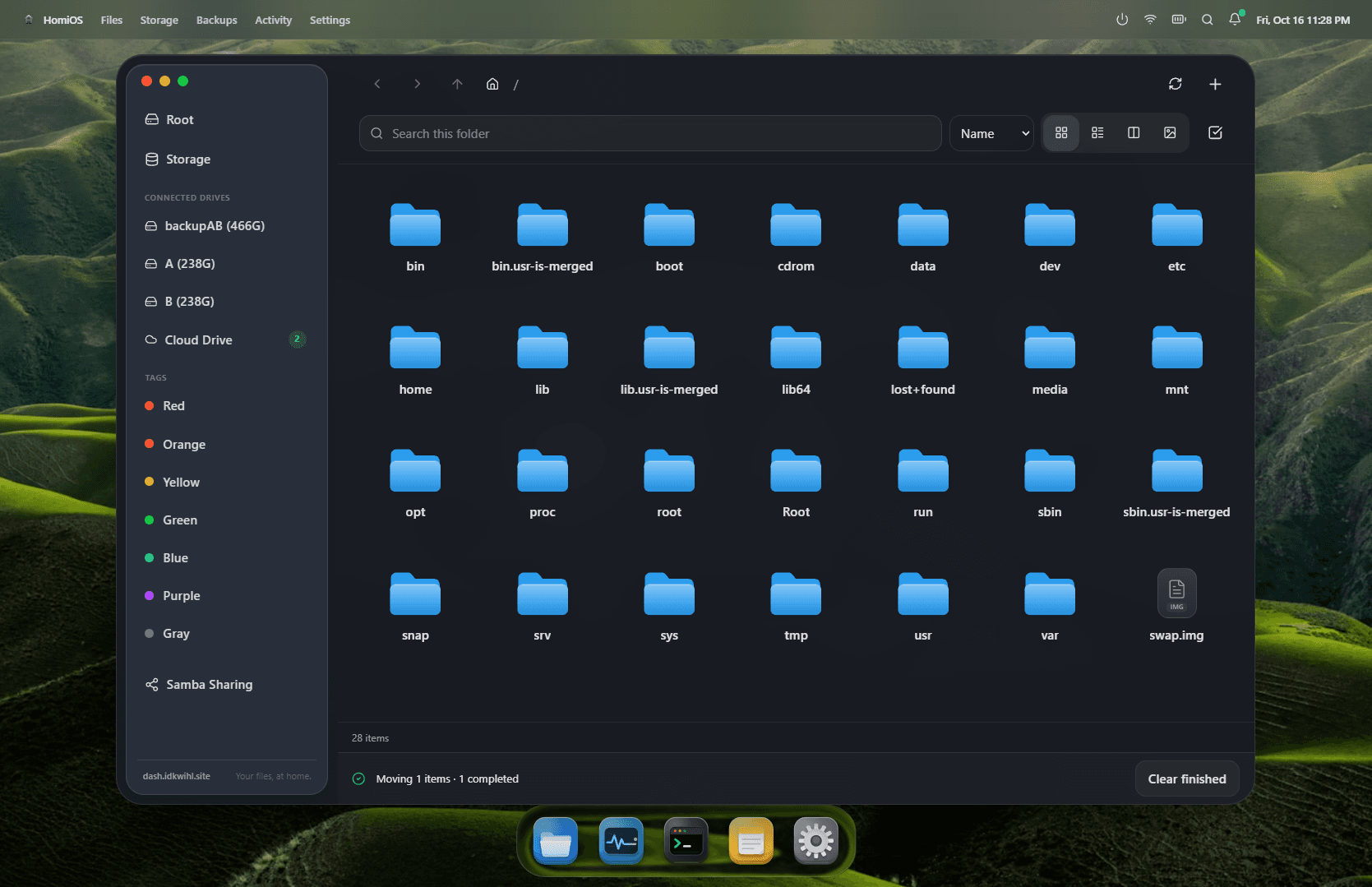
Your home server has a filesystem. It should have a proper file manager too. Advanced users still have Linux underneath; everyone else gets a filesystem they can actually use.
All connected drives pinned directly in the sidebar with root navigation.
Organize personal media, work assets, and docker configs with quick visual filters.
Fast folder and filename indexing across all mounted local and external drives.
Non-blocking transfers with progress bar, active job reporting, and status tray.

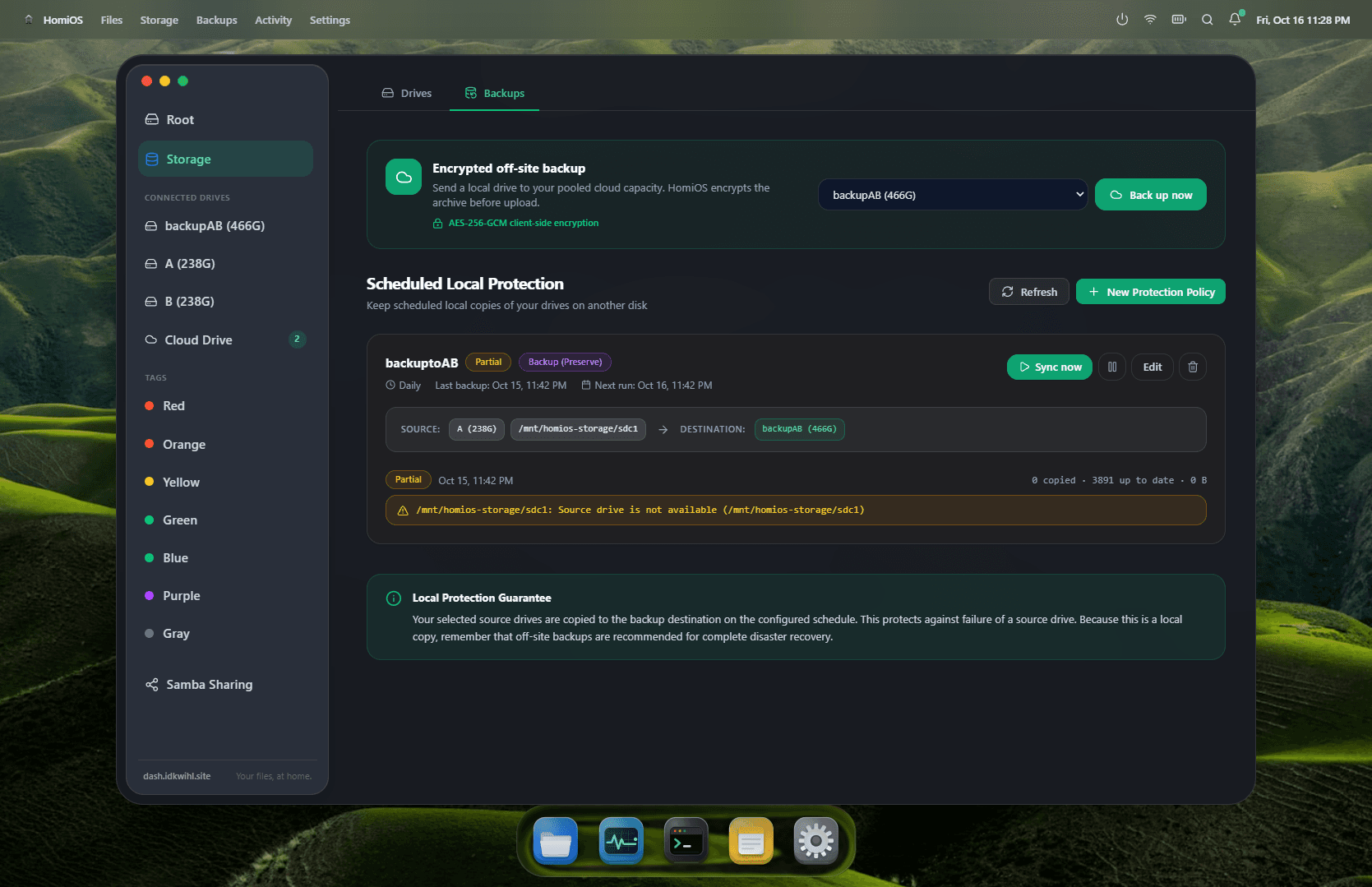
Not every home server needs complex RAID arrays. When you have two mismatched USB SSDs and a SATA HDD, HomiOS provides scheduled local protection directly between drives.
Copies source data to another drive while preserving existing files. Deleting a file from the source does never delete its destination copy.
Maintains an exact 1:1 replica of the source drive. File updates and deletions are propagated automatically to the destination drive.
Protects current data while retaining old replaced and deleted versions under HomiOS-managed version storage with configurable retention pruning.
Home servers aren't air-conditioned datacenters: USB cables get bumped, disks fill up, machines reboot. HomiOS writes to temporary files first, verifies them, then performs an atomic rename. A failed copy will never corrupt destination files.

smb.confSelect what you want to share, configure user access, and let HomiOS handle the underlying Linux Samba daemons and permissions automatically.
Mount your home server as a network drive. Drag and drop high-res 4K videos or project folders as if they were local.
Connect via the native iOS Files app or Android file manager to upload camera roll photos or backup personal files on WiFi.
Stream movies, home footage, and music collections straight to your living room Apple TV, Android TV, or Kodi setup.
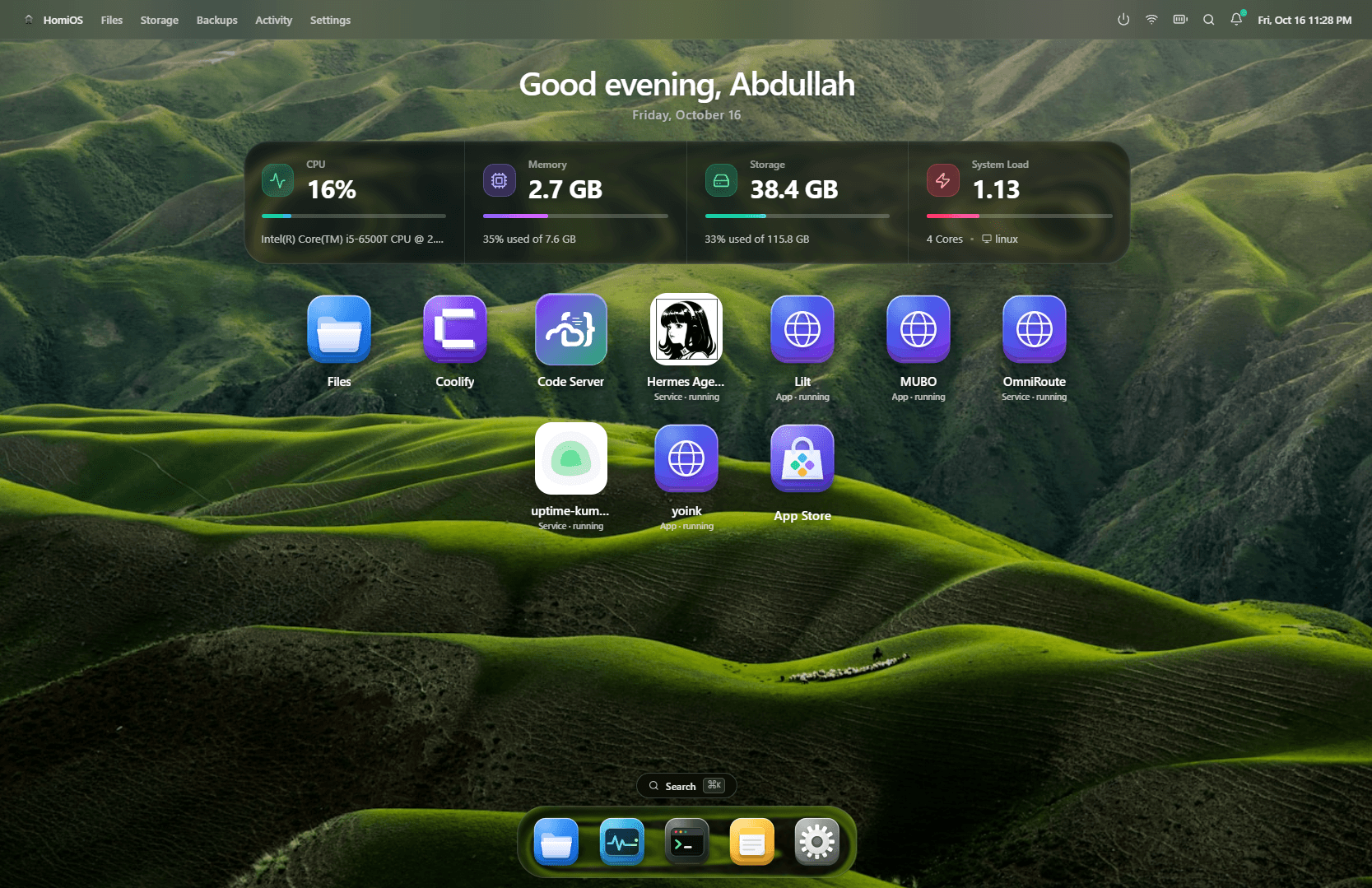
HomiOS is designed as an actual home-server environment. Live system telemetry is actionable rather than decorative, keeping you informed of resource demands and container health.
Easily launch containers or install your favorite services.
Self-hosted Heroku / Vercel alternative
VS Code in your browser on your server
Open-source local home automation
Local AI agent & LLM services
Self-hosted monitoring tool & status pages
High-speed media and stream downloader
Run the automated installation script on any freshly installed or existing Ubuntu, Debian, or Raspberry Pi OS machine.
curl -fsSL https://get.homios.dev | bashUbuntu 22.04+, Debian 12+, Raspberry Pi OS 64-bit, Fedora.
64-bit CPU, 2 GB RAM, 10 GB root partition space.
Standard port 80/443 for web interface, port 445 for Samba.
Honest answers about HomiOS's design principles, storage model, and recovery guarantees.